
By Dr Alice Shan & Dr Emily So, Dentists
Parents comparing notes at school pick-up quickly discover that no two children seem to get the same expander. One has a plate that comes out at night, another has something cemented in that nobody can remove, a third has a screw that gets turned twice a day and a fourth once a week. It is easy to conclude that somebody is getting the wrong treatment.
Usually nobody is. Expanders are a family of appliances that do a similar job in different ways, and the choice depends on the child, the bite and the plan.
What an expander actually does
The roof of the mouth is also the floor of the nose, and the upper jaw is in two halves joined down the middle by the mid-palatal suture. In children that join is open and easily separated, so gentle, sustained pressure outwards widens the whole upper jaw rather than simply tipping the teeth outwards. With age the suture becomes more tightly interlocked and the bone around it becomes more dense, particularly where the upper jaw meets the cheekbones. That is what changes, rather than the suture sealing itself shut at a set age. It is why the same appliance behaves differently at eight and at eighteen.
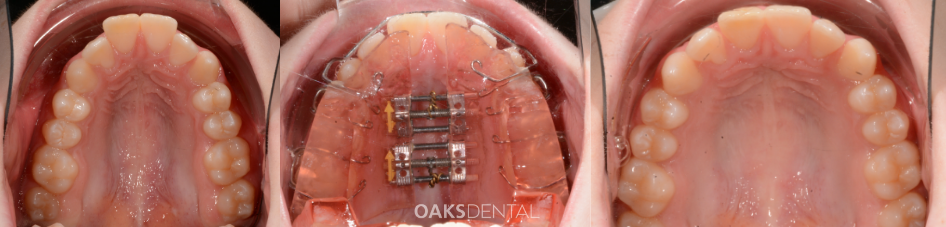
Widening the upper jaw can correct a crossbite, create room for adult teeth that would otherwise be crowded or blocked out, and may improve nasal airflow. It is often the first active step in early interceptive orthodontics, and it is one of the reasons we assess children early rather than waiting for all the adult teeth.
The main types
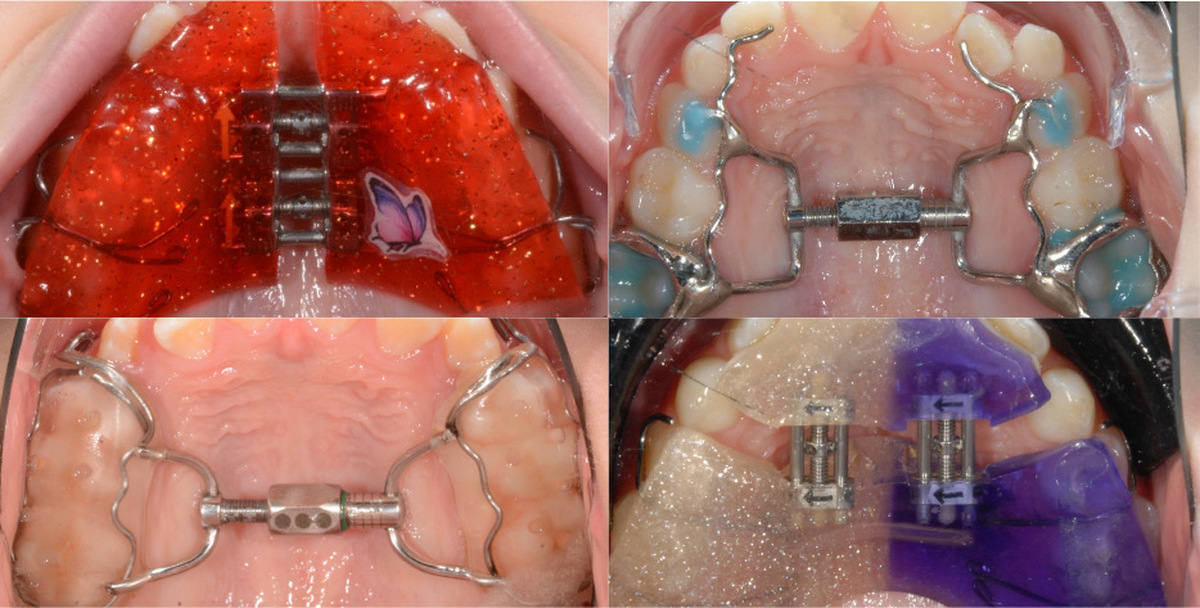
Removable plate expanders. An acrylic plate that clips onto the teeth with a screw in the middle, taken out for eating and brushing and turned at home on a schedule. They are comfortable, easy to clean and can do more than one job at once: a plate can carry extra screws to gain length as well as width, springs to move individual teeth, or a feature to help with a thumb or tongue habit. The catch is that they only work while they are in the mouth, so they ask something of the child and of you.
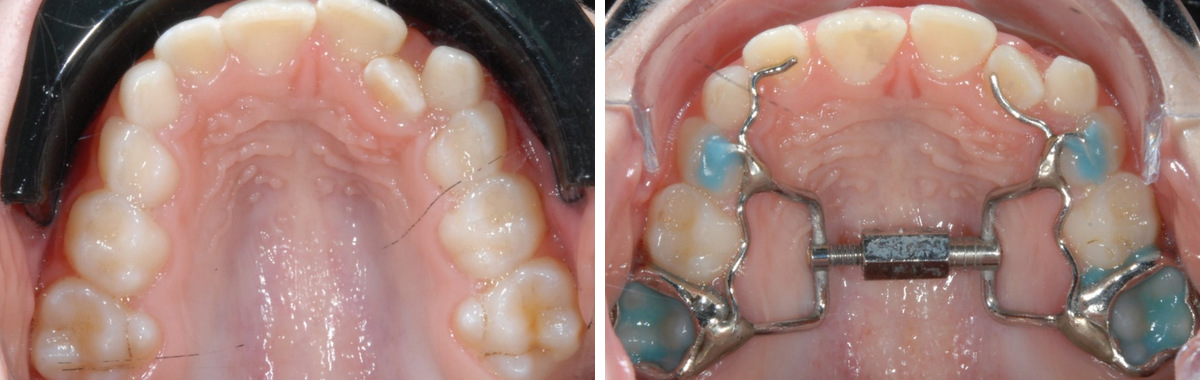
Fixed expanders. Cemented to the back teeth and not removable, with a screw in the middle turned with a small key. Nothing depends on a child remembering to wear it, and the force transfers more directly to the jaw, which is why they are often chosen for a clear crossbite or where a larger skeletal change is wanted. They come in two main forms. A banded expander is held by metal bands cemented around the back teeth. A bonded expander has acrylic covering the biting surfaces of the back teeth instead, which spreads the force across more teeth and lifts the bite slightly, useful where the upper and lower teeth are currently locking each other in place. Speech and swallowing feel odd for a few days with either, and brushing takes more care.
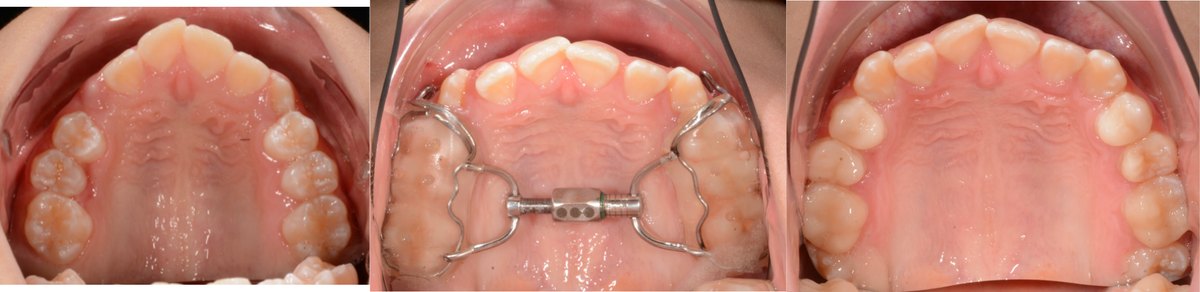
Slow, spring loaded expanders. Instead of frequent turns, these use a calibrated spring that delivers a gentler continuous force and is activated far less often. They are a fixed appliance with a slow protocol.
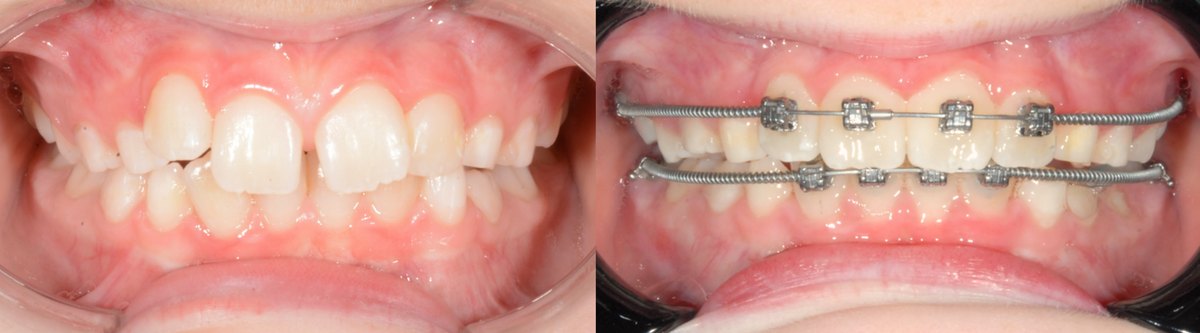
Partial braces alongside an expander. A fixed expander can be combined with braces on a small number of teeth, often called a 2×4 because it uses the two back molars and the four front teeth. In the de-gainer version of the technique, small open coil springs made from heat-activated copper nickel-titanium sit on the wire between the teeth and push gently and continuously to open or regain space, usually with passive self-ligating brackets such as Damon, which let the wire slide freely while the springs do the work.
So while the expander is widening the jaw, the front teeth can be aligned, a space opened or regained, or a tooth coming through in the wrong position redirected. Running both at once shortens the overall treatment and keeps it targeted, rather than putting a full set of braces on a child who does not need one.
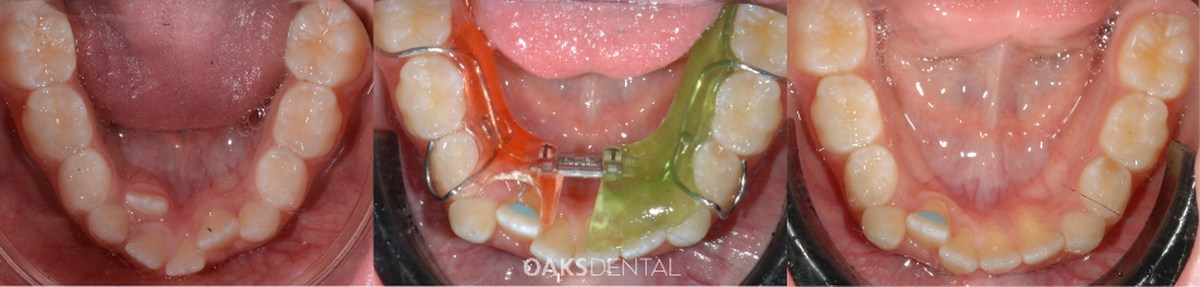
Lower arch appliances. The lower jaw has no suture down the middle, so it cannot be split the way the upper jaw can. Lower appliances develop the shape of the dental arch and upright teeth that have tipped inwards.
Which brings us to the real variables
Most expanders will do their job. What decides the outcome is usually not the hardware:
- Timing. Expansion works with growth. The state of the mid-palatal suture, which is related to age but not perfectly predicted by it, is the single biggest factor, and it is assessed individually rather than assumed from a birthday.
- Diagnosis. Whether the narrowness is skeletal or dental, whether the bite shift is genuine, what the airway and the muscles are doing. Widening a jaw that did not need widening is not a better outcome for having used a better appliance.
- The clinician. Appliance selection, anchorage, how far and how fast, when to stop, and how it is retained afterwards. This is where experience shows.
- Wear and turns. With a removable appliance, treatment happens at home between appointments. We would rather give a child a fixed appliance than a removable one they will not wear.
- Pace. How quickly the screw is turned changes the experience more than the end result, which is why we favour the gentler protocols.
Read more: Why We Expand Slowly: The Palate, the Nose and the Tonsils, which covers the fast versus slow question, what expansion does to the nasal airway, and how it fits alongside enlarged tonsils and adenoids.
After the width is gained
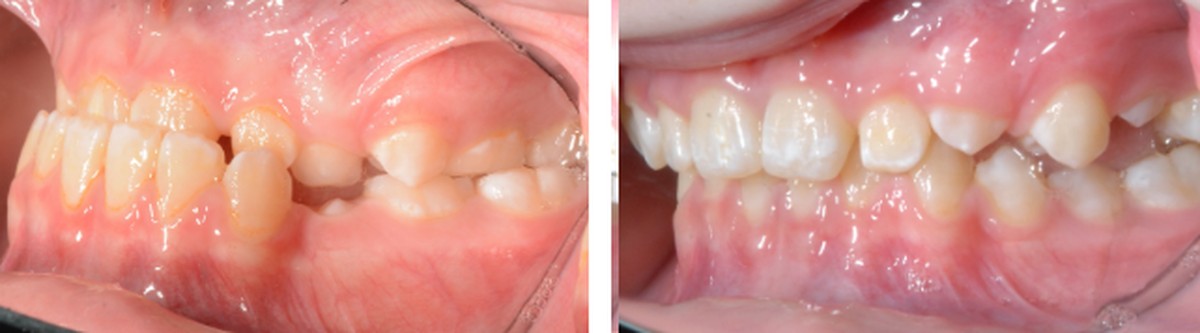
Expansion opens the suture faster than bone fills it, so the appliance stays in place passively for several months while that settles. Skipping this is how width is lost.
The other half of holding it is function. If the tongue can now reach the palate and the lips seal, the new shape has support from the inside. That is why myofunctional therapy so often runs alongside expansion, and why we check the tongue, the lips and the breathing before, during and after.
What about teenagers and adults?
In older teenagers and adults, a conventional expander tends to tip teeth rather than move bone. This is usually explained by saying the suture has fused, which is not quite right: the mid-palatal suture stays at least partly open well into adult life, and complete closure is uncommon at any age. What changes is how tightly interlocked it is and how much resistance comes from the surrounding bone, particularly around the cheekbones. Delivering the force into the bone itself, through miniscrews anchored in the palate, is what makes expansion work at that age, and we write about it in palatal expansion in adults. It is a good option, and it is a bigger undertaking than the same treatment at nine.
What to expect
Appointments are short. There is pressure rather than pain for the first day or two after a turn, a gap often opens between the front teeth and closes again on its own, and speech feels strange for a few days and then stops being noticeable. Children adapt faster than their parents expect.
If you have been told your child has a narrow upper jaw, a crossbite or crowding, or you simply want to know whether anything needs doing yet, an assessment will tell you where they are in their growth and what the options are. Book online or call (02) 9096 3895.
Any surgical or invasive procedure carries risks. Before proceeding, you should seek a second opinion from an appropriately qualified health practitioner.
References
Angelieri F, Cevidanes LHS, Franchi L, Gonçalves JR, Benavides E, McNamara JA. Midpalatal suture maturation: classification method for individual assessment before rapid maxillary expansion. American Journal of Orthodontics and Dentofacial Orthopedics 2013;144(5):759–69. pmc.ncbi.nlm.nih.gov
N’Guyen T, Ayral X, Vacher C. Radiographic and microscopic anatomy of the mid-palatal suture in the elderly. Surgical and Radiologic Anatomy 2008;30(1):65–8. link.springer.com
Gautam R, Deshmukh S, Rahalkar J, Chakravarty S. Skeletally anchored maxillary expansion: a current consensus. Journal of Indian Orthodontic Society 2026;60(2):78–100. journals.sagepub.com
FAQs
1. What age is best for an expander?
It is most straightforward while the suture is still loosely interlocked, generally in childhood and early adolescence. There is no age at which it simply stops being possible, and how mature any particular child is varies, so we assess it individually rather than going by age alone.
2. Is a fixed expander better than a removable one?
Neither is better in the abstract. Fixed appliances do not depend on wear and transfer force more directly. Removable plates are comfortable and can do several jobs at once. The right choice depends on the bite, the aim and the child.
3. Does an expander hurt?
There is pressure for a day or two after each turn rather than pain, and a feeling of tightness across the nose and cheeks. The gentler protocols we use make this milder again, and most children manage without pain relief.
4. Why has a gap appeared between my child’s front teeth?
It is a sign the jaw is widening as intended. It usually closes on its own once expansion stops.
5. How long does it stay in?
Because we prefer semi-rapid and slow expansion, active expansion usually takes several months rather than weeks. The appliance then stays in passively for several months more while bone fills the opened suture, which is what stops the width being lost.