
Patient education | Straightening teeth
When a Back Tooth Won’t Come Through: Impacted Molars in Children
A back tooth can come in crooked and quietly take the space the front teeth needed. Caught by seven, a small elastic ring often fixes it.
Two quite different situations share this name, and it’s worth separating them, because they happen at different ages and need different things.
The six-year molar that arrives at an angle
The first adult molars come through at around six, right behind the last baby teeth, without anything falling out first, which is why a lot of parents never register their arrival at all.
Sometimes one comes in tipped forward instead of straight up, and catches underneath the back of the baby molar in front of it. It gets stuck there. The clinical name is ectopic eruption; it turns up in somewhere between two and six children in a hundred, and it happens several times more often in the upper jaw than the lower.
From there it goes one of two ways. Either the molar works itself free and comes up normally, and where that happens, it has usually happened by about age seven. Or it stays locked, and then a few things follow: the molar presses on the root of the baby tooth and dissolves part of it away, the baby tooth can be lost years earlier than it should be, and the adult molar drifts forward into the gap.
That last point is the one that matters most, and it connects to everything else on this site about space, and to why we assess children at around seven. The length of the dental arch is fixed. When a molar drifts forward into space that was reserved for the teeth still to come, that space is gone, and crowding later is the result. A back tooth nobody was looking at has quietly decided something about the front teeth.
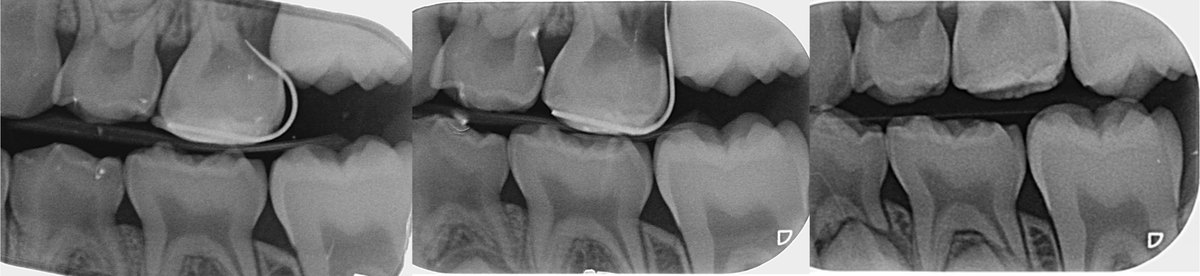
What you would notice
Very little, and that’s the problem. There is usually no pain. Occasionally there’s food packing in one spot, a baby molar that becomes wobbly much too early, or an abscess if the baby tooth’s nerve gives up. Most often it is found on a routine x-ray, or because the adult molar is visibly late on one side compared with the other.
If you have ever noticed that one back tooth seems to be coming through and its partner on the other side isn’t, that’s worth mentioning.
What fixes it
The treatment scales with how stuck it is, which is the argument for finding it early:
- Mildly caught, found early. A separator, a small elastic ring wedged between the two teeth for a week or two, is sometimes all it takes to nudge the molar free. Cheap, quick, no appliance.
- More established. Something is needed to tip the molar back and move it away from the tooth in front: a spring, a small fixed appliance, or a distalising device.
- Where the baby tooth is beyond saving. It comes out, and a space maintainer holds the gap so the adult molar can’t drift forward while we wait for the tooth underneath.
Twelve-year molars, and wisdom teeth
The second adult molars arrive at around twelve, behind the first ones. These can impact too, usually running into the back of the six-year molar rather than under a baby tooth, since there is no baby tooth there. It is less common, found later, and typically needs mechanics to upright the tooth rather than a simple separator.
Wisdom teeth are a separate conversation entirely and belong in their own article. Being impacted is close to normal for a wisdom tooth and doesn’t automatically mean it needs to come out.
What we do here
We check the eruption pattern at routine visits and compare the two sides, which is often what flags it. We place separators, fit and manage the appliances that tip a caught molar back, and make space maintainers where a baby molar has been lost early, which sits alongside the rest of our care for children. Where the case calls for specialist orthodontic care, we refer.
Most of these are picked up at an ordinary check-up between six and eight, which is the practical reason for keeping those visits regular through that age range.
References
Treatment of ectopic first permanent molar teeth. Dental Update. www.dental-update.co.uk
Frequently asked questions
Is it painful for my child?
Usually not at all, which is why it tends to be found rather than reported.
Will it sort itself out?
Sometimes, and where it does, it has generally happened by about seven. Past that age, spontaneous correction becomes much less likely and waiting starts to cost space.
Does a separator hurt?
It feels tight for a day or so, similar to food caught between teeth. Most children forget about it after that.
Why does losing a baby molar early matter so much?
Because the adult molar behind it moves forward into the gap, and the space it takes was needed by the teeth still to arrive. That’s what a space maintainer prevents.
Does this mean braces later?
Not necessarily. Sorting it early is partly about reducing the chance of that, though it’s not a guarantee either way.
How is it found?
Usually on a routine x-ray, or from a molar that is clearly late on one side. There is rarely anything to see from the outside.

About the authors
Dr Emily So and Dr Alice Shan are the principal dentists and co-owners of Oaks Dental in Neutral Bay. They are committed to providing thoughtful, evidence-based care that looks beyond treating individual teeth to support each patient’s overall oral health, function and wellbeing.
Disclaimer
All dental procedures involve potential risks and benefits. The information provided in this blog is general in nature and should not be taken as medical advice. We recommend that you seek guidance from a suitably qualified health professional before making decisions about your oral health. Where appropriate, you may also wish to consider obtaining a second opinion.
Any images or videos featured are shared with the informed consent of our patients and are intended for educational purposes only. They are not a guarantee of results, as every patient is unique. Treatment outcomes, including recovery, potential complications and effectiveness, can vary from person to person.
Has one back tooth come through and not the other?
A molar that is clearly late on one side is worth a look. We compare the two sides at every visit from six, and most of these are found exactly that way.