
Patient education | Jaw growth & expansion
Mandibular Advancement: Why the Timing of Jaw Growth Matters
Guiding a small lower jaw forward works in a short window around the growth spurt. Start years too early and the same appliance does far less.
“Mandibular advancement” simply means bringing the lower jaw forward. The trouble is that it describes two treatments, for two different problems, in two different age groups, and a great deal of confusion comes from people reading about one and thinking they’ve read about the other. Most of this article is about the first.
In a growing child: guiding the jaw, not just the teeth
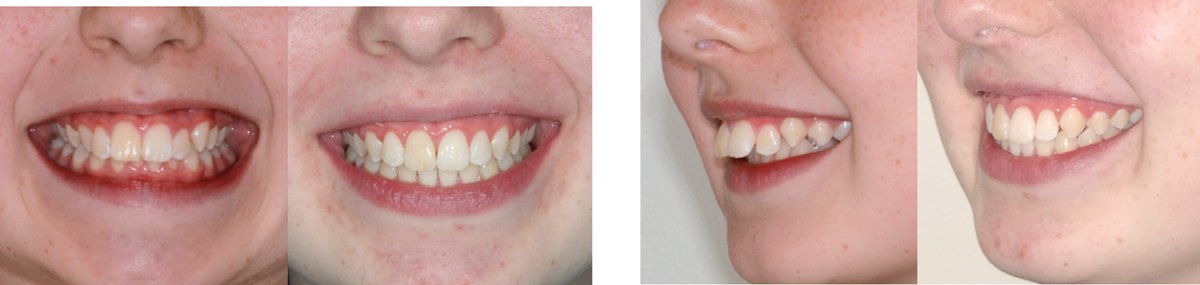
Some children have a lower jaw that sits back relative to the upper one. What a parent sees is upper front teeth that stick out, usually called an overbite, though the accurate term is a large overjet.
It’s worth being clear about what those protruding teeth actually represent. In most of these children the teeth are not the problem. The lower jaw is set back, and the teeth are simply reporting it. Straightening the teeth alone would tidy the symptom and leave the anatomy as it was.
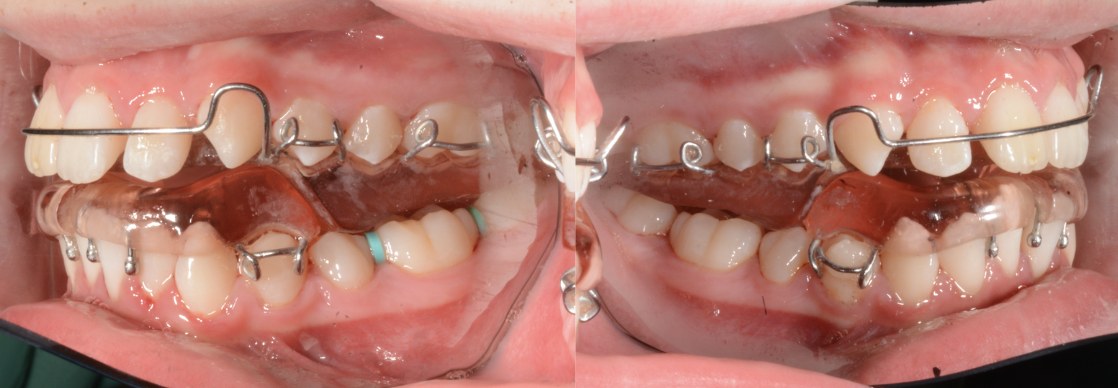
A functional appliance, the twin block being the most common, is a removable device worn in both jaws that postures the lower jaw forward when the teeth come together. Worn consistently through the right growth period, the aim is to let the lower jaw develop in that more forward position: normalising the anatomy rather than camouflaging it.
The bit almost nobody explains: when
This is the whole thing, and it is where most of the disagreement about functional appliances comes from.
The lower jaw doesn’t grow at a steady rate. It has a pubertal growth spurt, and there is a relatively short window during and just after the onset of that spurt when the jaw is growing fastest and is most responsive to being guided.
A well-known study of twin block timing compared two groups: children treated at around nine, before the pubertal peak, and children treated at twelve to thirteen, at or just after its onset. The later group gained supplementary mandibular length at 4.75 mm per year against 1.88 mm per year in the early group: more than double. The direction of condylar growth differed too, and the skeletal contribution to correcting the bite was greater in the later group. The authors concluded that optimum timing appears to be during or shortly after the onset of the pubertal peak in growth velocity.
So the question is not really whether functional appliances work. It is whether the appliance was in the mouth during the months that mattered.
What the Cochrane review says, read properly
You may come across the Cochrane review on this, and it is often quoted as showing that early treatment is pointless. Read carefully, it says something more specific and more useful.
It compared early treatment (a first phase between seven and eleven, mostly before the growth spurt) with a single course of treatment in adolescence. Its finding was that the two-phase approach produced no better final overjet or jaw relationship than treating once in the teens. It also found early treatment reduced injuries to the front teeth by about a third: new incisal trauma in about 20% of early-treated children against 29% of those who waited. Certainty was rated low to moderate.
Put that beside the timing research and it stops being a contradiction. The Cochrane “early” group was treated before the growth spurt, the timing the evidence says is least productive, and the “late” group was treated in adolescence, which is much closer to the peak. Read that way, the review is not evidence that guiding jaw growth doesn’t work. It is evidence that starting years too early buys you very little, and costs a child two or three extra years in appliances to get there.
Which is exactly why we assess growth stage rather than going by age, and why a first orthodontic assessment at around seven is about looking rather than treating.
How we work out where a child is in their growth
Chronological age is a poor guide: two twelve-year-olds can be a long way apart, and girls generally reach the peak earlier than boys. What we actually use:
- Skeletal maturity assessed from the shape of the cervical vertebrae on a lateral cephalometric x-ray, which is a well-established way of placing a child relative to their growth peak
- Height records over time: the growth chart at home is genuinely useful, and we’ll ask for it
- The usual markers of pubertal development, discussed with you rather than the child where that’s more comfortable
- Family history, since the timing of a growth spurt tends to run in families
Frequently a first assessment lands before the productive window has opened. That doesn’t mean we send you away for two years. It means we track growth properly so we catch the window when it arrives, and in the meantime we work on the things that shape how a jaw develops in the first place: nasal breathing, sleep, and the resting posture of the tongue and lips.
The airway side, with the evidence attached
There is a second reason we take this seriously. The tongue is anchored to the lower jaw. A lower jaw that sits back carries the tongue back with it, into the space behind it: the oropharynx, the part of the airway where narrowing most often occurs during sleep. Bringing the jaw forward during growth increases that space. The same questions come up around snoring and mouth breathing in children, which we screen for at every check-up.
That is measurable. A systematic review with meta-analysis in the Journal of Clinical Medicine pooled 20 studies covering 969 patients and found oropharyngeal volume increased by an average of about 2,356 mm³ (95% confidence interval 1,276–3,436) after functional appliance treatment, with removable appliances producing greater effects than fixed ones.
And here is the part we’d rather tell you ourselves than have you find later. The authors rated the quality of that evidence as very low, all 20 studies were non-randomised, and they noted the changes were small to moderate and that the clinical relevance of an increase in airway dimensions remains unclear: it needs confirmation in how people actually breathe, not just in how much space shows on a scan.
So: the space increases, and that is a real finding. Whether that translates into better breathing or better sleep for a given child is not something the current evidence lets anyone promise, and we won’t. What it does mean is that where a child has both a retruded lower jaw and a sleep picture that concerns you, treating the jaw at the right time is a reasonable thing to do for more than one reason: alongside, not instead of, proper assessment of the sleep itself.
The third reason, which is simpler
Prominent upper front teeth get broken. They are knocked in the playground, in the pool and on the sports field considerably more often than teeth that sit back, and the Cochrane figures above put real numbers on how much that risk falls. For a child who plays contact sport or still falls a lot, this alone can justify acting, and a properly fitted mouthguard is the immediate half of that conversation.

Who it suits
The clearest candidates are children approaching or entering their growth spurt with a genuinely retruded lower jaw, particularly where there is also snoring, mouth breathing or disturbed sleep, or where the upper front teeth are exposed enough to be at risk. For a mild overjet in a child with none of that, waiting and watching is a perfectly good plan, and we’ll tell you so rather than fit something.
In an adult: mandibular advancement splints
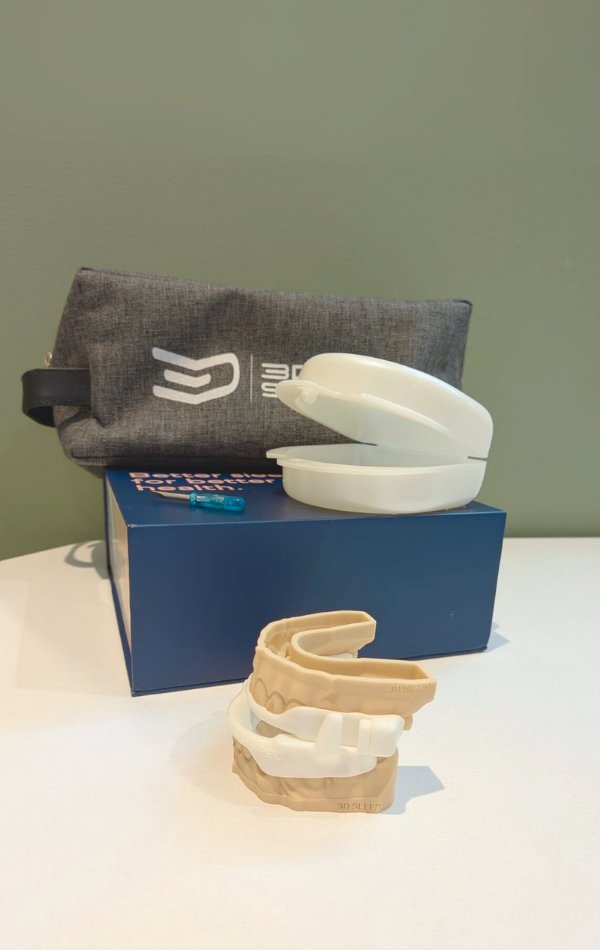
Same phrase, completely different treatment. Here the device is worn at night and holds the lower jaw slightly forward while you sleep. Because the tongue is attached to the lower jaw, moving it forward tends to open the space behind the tongue, which is where the airway most often narrows.
These are used for snoring, and for obstructive sleep apnoea, in people who cannot tolerate CPAP or prefer an alternative. Current sleep medicine guidance does not restrict them by severity, though CPAP remains the first-line treatment in severe disease.
One thing has to happen first: a diagnosis. Snoring is a symptom, not a condition, and it can accompany anything from a blocked nose to significant sleep apnoea. A dentist can make and fit the device and manage it well. A dentist cannot tell you whether you have sleep apnoea or how severe it is: that comes from a sleep physician, usually with a sleep study. We won’t make a splint for someone who hasn’t been assessed, because a device that quietens the snoring while leaving apnoea untreated is a genuinely bad outcome.
The side effects, stated plainly
Worth knowing before you start rather than after:
- Jaw muscle ache and tenderness in the mornings, especially in the first few weeks
- Increased saliva, or a dry mouth, early on
- Over months and years, the teeth can move and the bite can change: this is the significant one, it is well documented, and it is why we review the bite regularly rather than fitting a device and waving you off
- Jaw joint discomfort in some people
Most people find the trade worthwhile. But it should be a trade you made knowingly.
What we do here
We assess and manage functional appliance treatment in growing children, and we make, fit and monitor mandibular advancement splints for adults who have a diagnosis. We work with sleep physicians and ENT surgeons on the adult side, and refer to a registered specialist orthodontist where a case calls for it.
If you’re a parent who’s been told your child “needs a plate”, or an adult who has been told you snore and doesn’t know where to start, either is a reasonable thing to bring to a normal appointment.
Any surgical or invasive procedure carries risks. Before proceeding, you should seek a second opinion from an appropriately qualified health practitioner.
References
Baccetti T, Franchi L, Toth LR, McNamara JA Jr. Treatment timing for Twin-block therapy. American Journal of Orthodontics and Dentofacial Orthopedics 2000;118(2):159–70. bbo.org.br
Batista KBSL, Thiruvenkatachari B, Harrison JE, O’Brien KD. Orthodontic treatment for prominent upper front teeth (Class II malocclusion) in children and adolescents. Cochrane Database of Systematic Reviews 2018; CD003452. www.cochrane.org
Bidjan D, Sallmann R, Eliades T, Papageorgiou SN. Orthopedic treatment for Class II malocclusion with functional appliances and its effect on upper airways: a systematic review with meta-analysis. Journal of Clinical Medicine 2020;9(12):3806. www.mdpi.com
Ramar K, et al. Clinical practice guideline for the treatment of obstructive sleep apnea and snoring with oral appliance therapy. Journal of Clinical Sleep Medicine 2015;11(7):773–827. doi.org
Frequently asked questions
What age should my child have a twin block?
Age isn’t the right question: growth stage is. The productive window is during or just after the onset of the pubertal growth spurt, which arrives at different times in different children and generally earlier in girls. We assess where your child actually is rather than going by their birthday.
We were told to start at eight. Is that wrong?
Not wrong, but the research suggests it’s inefficient for jaw growth: treating well before the spurt produced less than half the supplementary mandibular length of treating at the peak, and typically means more years in appliances. There are situations where starting early is justified: front teeth at real risk of injury is the main one.
Does a twin block actually make the jaw grow?
Treated at the right point in growth, studies show meaningfully more mandibular length than treating early. How much of that is extra growth versus growth expressed differently is still debated, and we’d rather say that than overstate it.
Will it help my child’s breathing or sleep?
It measurably increases the space in the oropharynx. Whether that improves breathing or sleep for a particular child is not something the current evidence supports promising, and if sleep is your main concern your child should also be assessed by a GP or paediatrician.
How long is it worn?
Typically most of the day and night for around nine to twelve months, followed by a period of retention. Compliance is the single biggest factor in whether it works, more than the appliance design.
What if we’ve missed the growth spurt?
Then the honest conversation is a different one, about camouflage treatment or, in significant cases, surgical options in adulthood. It’s the reason we’d rather see a child at nine to start monitoring, even when the answer that day is to wait.
Can I get a snoring device without a sleep study?
We’d rather you didn’t, and we don’t make them that way. Treating the noise without knowing what’s behind it can leave real sleep apnoea untreated.
Will a splint change my bite?
It can, over time. It’s the main long-term side effect and the reason for regular review.
What will it cost?
That depends on what’s involved, so we give you a written plan with the costs on it before anything starts. Bring your health fund details to the appointment and we can check what your level of cover contributes.

About the authors
Dr Emily So and Dr Alice Shan are the principal dentists and co-owners of Oaks Dental in Neutral Bay. They are committed to providing thoughtful, evidence-based care that looks beyond treating individual teeth to support each patient’s overall oral health, function and wellbeing.
Disclaimer
All dental procedures involve potential risks and benefits. The information provided in this blog is general in nature and should not be taken as medical advice. We recommend that you seek guidance from a suitably qualified health professional before making decisions about your oral health. Where appropriate, you may also wish to consider obtaining a second opinion.
Any images or videos featured are shared with the informed consent of our patients and are intended for educational purposes only. They are not a guarantee of results, as every patient is unique. Treatment outcomes, including recovery, potential complications and effectiveness, can vary from person to person.
Not sure whether it is the right time yet?
We assess growth stage rather than going by age, so we can tell you whether to start now, or exactly what we would be watching for before we do.