

By Dr Emily So & Dr Alice Shan, Dentists
Two children can be given the same expander and be asked to turn the screw at completely different rates. One parent is told twice a day for three weeks, another once every few days for several months. Both are legitimate, and the difference is not arbitrary.
This is the companion piece to our guide on the different types of expanders. That one covers what the appliances are. This one covers how fast they are turned, what that does to the nose as well as the teeth, and what happens when enlarged tonsils and adenoids are part of the same picture.
Fast, slow, and what we prefer
Rapid expansion turns the screw once or twice a day and aims to gain the width in a few weeks. Semi-rapid and slow protocols use fewer turns, spread over a longer period, so the bone and the surrounding tissues are asked to adapt gradually rather than all at once.
We generally use semi-rapid and slow expansion, and less frequently rapid expansion. It is more comfortable, it is gentler on the teeth and the gum around them, and it gives us more control over where the width ends up. The trade-off is time: even in children, active expansion with us usually runs over several months rather than a few weeks. We would rather take that time than rush it.
The research supports the approach.
A 2022 systematic review and meta-analysis of what patients themselves reported found slow expansion significantly more comfortable than rapid in the first week, with no meaningful difference by weeks two to four. On the dental and skeletal side, reviews find the two protocols produce comparable arch width, with rapid expansion giving slightly more skeletal change at the back and slow expansion less tipping of the molars. A 2026 systematic review comparing a spring based slow expander with conventional rapid expanders found both effective, with no statistically significant difference in the widths measured across the arch, though the two achieved it in slightly different ways. Its authors made the point we would make: the choice of appliance should rest on biomechanics, what the appliance is anchored to, compliance, comfort and the individual treatment aim, rather than on an expectation that one device simply produces more width.
Slow expansion and the nose
There is a second reason we lean towards the gentler protocols, and it has to do with shape rather than width. The roof of the mouth is the floor of the nose, so what happens to the palate happens to the nasal airway above it. The aim is not only a wider jaw but a flatter, lower palate, which brings the floor of the nose down with it and opens the space for air to move through.
CBCT studies show expansion increases nasal cavity volume in growing children. In a small trial comparing slow with rapid miniscrew-supported expansion in adolescents, the slow group gained more width at the front of the nasal cavity while the rapid group gained more width between the molars. A larger comparison found both approaches increased nasal, nasopharyngeal and sinus volume, without a significant difference between them. A systematic review of expansion and nasal breathing in children found nasal resistance fell and nasal airflow rose after treatment, while cautioning that breathing alone is not a reason to expand.
So the evidence supports the general point, that widening the upper jaw opens the nasal airway, more firmly than it settles the question of which protocol changes the shape of the palate most favourably. We treat the palatal shape argument as clinical reasoning, which is how we would present it to you.
Expanders, tonsils and adenoids
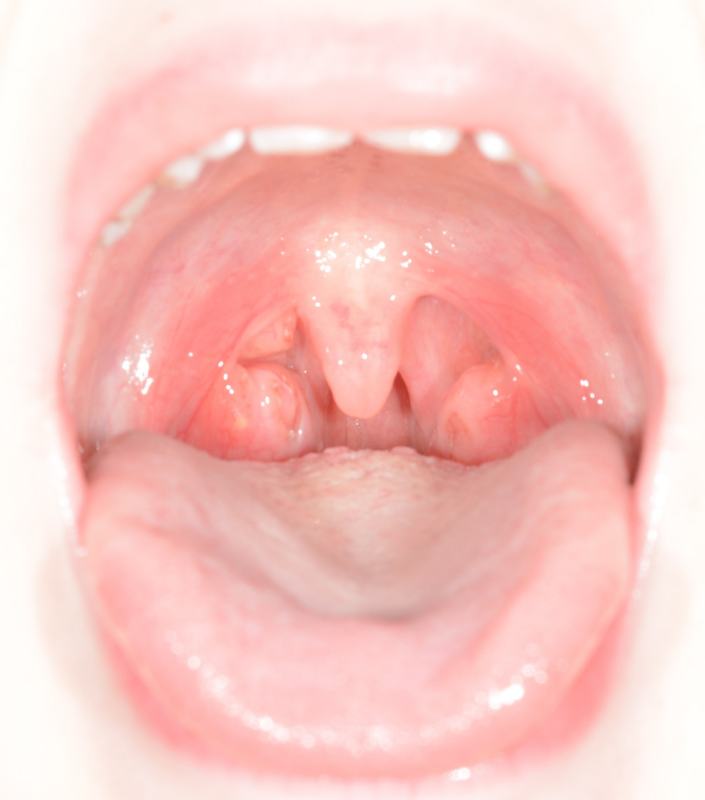
Where a child has both a narrow upper jaw and enlarged tonsils and adenoids, families are often told to choose between them. A 2026 study of 80 children aged seven to nine with sleep-disordered breathing looked at what happens when you do both. Every child had semi-rapid expansion and removal of the tonsils and adenoids, in one order or the other. Whichever came first produced roughly a 45 to 50% fall in the number of breathing events recorded overnight, and after both treatments the fall was around 74 to 79%.
Two things are worth saying about that. The study had no untreated comparison group, and children do improve with growth alone, so the size of the effect is uncertain. And the number it measures counts breathing events, which is one dimension of a night’s sleep rather than the whole of it: a child can have a reassuring number and still sleep badly. What it does support is the approach we take, which is to look at the whole airway rather than pick a single culprit, and to work alongside an ENT colleague where the tonsils and adenoids are part of the picture.
If your child snores most nights or sleeps with their mouth open, that is worth raising with us and with your GP. Read more: Snoring and Mouth Breathing in Children: When It’s Worth a Closer Look.
What this means in practice
None of this makes slow expansion the right answer for every child. It makes it our starting position, to be argued out of by the individual case: how mature the suture is, how much width is needed, how the appliance is anchored, and what else is going on in the airway.
The same principles apply to adults. Once the mid-palatal suture has fused, expansion needs skeletal anchorage rather than teeth to push against, and the better known version is MARPE, where miniscrews in the palate carry the force and the screw is turned rapidly. The slow counterpart is MASPE, miniscrew-assisted slow palatal expansion: the same appliance and the same anchorage, activated more gently over a longer period. We offer both, and choose between them case by case on what the imaging shows and what suits the individual. Rapid against slow expansion in adults is an actively evolving area, and the research behind it is progressing. We have written separately about what adult expansion involves.
If you have been told your child needs an expander and you would like to understand the pace as well as the appliance, an assessment will tell you where they are in their growth and what the options are. Book online or call (02) 9096 3895.
Any surgical or invasive procedure carries risks. Before proceeding, you should seek a second opinion from an appropriately qualified health practitioner.
References
Rutili V, Nieri M, Franceschi D, et al. Comparison of rapid versus slow maxillary expansion on patient-reported outcome measures in growing patients: a systematic review and meta-analysis. Progress in Orthodontics 2022;23:47. pmc.ncbi.nlm.nih.gov
Caramaschi E, Verdecchia A, Ledda M, et al. Transverse maxillary correction: leaf expander vs. rapid maxillary expansion appliances, a systematic review and meta-analysis. Children 2026;13(3):396. pmc.ncbi.nlm.nih.gov
Lanteri V, Farronato M, Ugolini A, et al. Volumetric changes in the upper airways after rapid and slow maxillary expansion in growing patients: a case-control study. Materials 2020;13(10):2239. mdpi.com
Yacout YM, El-Harouni NM, Madian AM. Dimensional changes of upper airway after slow vs rapid miniscrew-supported maxillary expansion in adolescents: a CBCT study. BMC Oral Health 2022;22:529. link.springer.com
Calvo-Henriquez C, Capasso R, Chiesa-Estomba C, et al. The role of paediatric maxillary expansion on nasal breathing: a systematic review and meta-analysis. International Journal of Pediatric Otorhinolaryngology 2020;135:110139. sciencedirect.com
Mahony D, Bhattarai N, Petocz P. Maxillary arch expansion and adenotonsillectomy in prepubertal children diagnosed with paediatric obstructive sleep apnoea: an interventional study. Journal of Clinical Medicine 2026;15(8):2981. mdpi.com
FAQs
1. Is slow expansion less effective than rapid?
No. Reviews find comparable arch width from both. Rapid gives slightly more skeletal change at the back, slow gives less tipping of the molars, and slow is more comfortable in the first week.
2. Why does it take so much longer with you?
Because we turn the screw less often. Active expansion usually runs over several months rather than a few weeks, which is gentler on the teeth and the gum around them and gives us more control over where the width ends up.
3. Will an expander fix my child’s snoring?
Widening the upper jaw may improve nasal airflow, and it is not a treatment for sleep apnoea. Snoring in children should be assessed properly, and we work with medical specialists where that is needed.
4. Does my child need their tonsils out first?
Not necessarily, and it is not an either-or. The available study found a meaningful improvement whichever came first, and a larger one after both. Which order suits your child is a conversation between us, your GP and an ENT.
5. Can a dentist diagnose sleep apnoea?
No. Diagnosis comes from a paediatrician or sleep physician, sometimes with a sleep study. What we can do is examine the structures that affect how much room there is to breathe, and refer on.
6. Which type of expander will my child have?
That is a separate question from the pace, and it is covered in our guide to the different types of expanders.