
Patient resources | Crowns and onlays
Crowns, Onlays and Inlays
Why we recommend them, your other options, what to be aware of during and after treatment, and how to get the most from your crown.
Download PDFDental crowns and onlays are an excellent way to fix and/or protect heavily filled or broken-down teeth. For root canal treated teeth, crowns have been shown to help teeth last longer by providing a good seal and strong mechanical reinforcement.
Modern dental ceramics can be made to closely mimic natural teeth, so your crown can look and feel much like a natural tooth. If you have chosen gold, you can have peace of mind that it is one of the most durable materials available, even in the harshest conditions.
Success and longevity
At Oaks Dental, we take great pride in our work and always aim to deliver the best results for our patients. However, as with any medical or dental procedure, individual patient factors can affect the final outcome, and some are beyond our control. These include, but are not limited to, your diet, oral hygiene habits and how often you see us.
All dental work has a lifespan. The best insurance against early problems is to take great care of your teeth and attend your regular check-ups.
Other options available to you
- No treatment. This may lead to more costly treatment, or the tooth deteriorating beyond repair.
- A large filling. Less long-term protection for the tooth than a crown, and more prone to failure. In some cases it will not give a satisfactory aesthetic result.
- Referral to a prosthodontist (a specialist in the field).
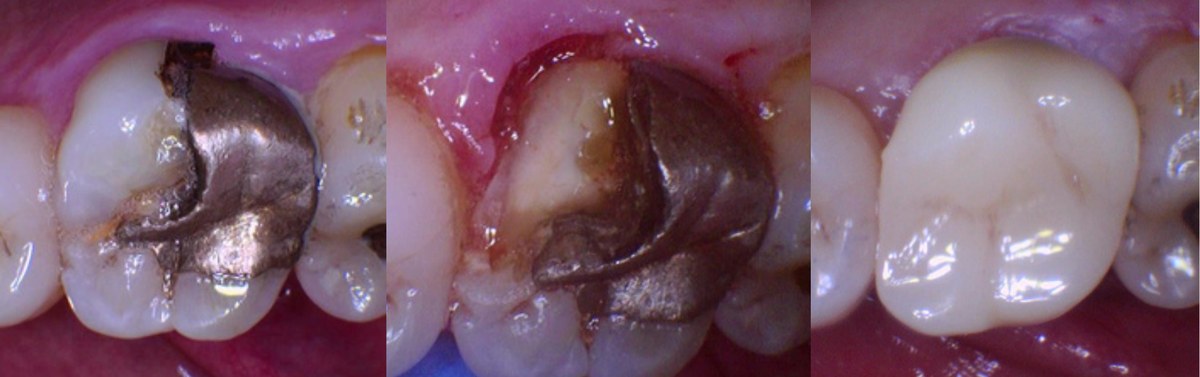
Things to be aware of during the procedure
Removing some natural tooth and old restorations is often needed so the crown sits on a solid foundation. This is done as conservatively as possible, with the utmost care.
Sensitivity is a common reaction after any complex dental procedure. It is generally short-lived and resolves with time.
Your temporary crown
You will be given a temporary crown after your first visit while your crown is made by the technician. This is an important part of your treatment: it protects your tooth and stops the neighbouring and opposing teeth from moving.
We will give you instructions on caring for your temporary crown after your preparation visit. You can also read them here: crown preparation aftercare.
Things to be aware of after the procedure
If your tooth has a history of nerve inflammation, or an existing deep cavity or filling, there is always a risk that the nerve becomes irreversibly affected during treatment. The tooth may then need root canal treatment, ideally before the crown is fitted, or sometimes in the future after fitting.
If your dentist is concerned about the nerve, you may need to keep your temporary crown on for longer and return for a review before the crown is fitted.
It is very important to tell your dentist about any symptoms close to the day your final crown is fitted.
Dental anaesthetic is often used, so you may have some mild tenderness and swelling where the injection was given. The numbness or tingling is usually short-acting but can last longer in some people. Permanent changes in sensation are a very rare complication of dental anaesthetics.
Despite their strength, crowns can occasionally fracture under excessively heavy forces such as uncontrolled grinding or clenching, biting unusually hard foods or objects, or a fall or trauma. We do, however, replace crowns that break early because of a defect in how they were made.
Questions?
If you would like to talk through your options in more detail, call us on (02) 9096 3895 or email [email protected].
Disclaimer
All dental procedures involve potential risks and benefits. This information is general in nature and does not replace advice from your dentist. Any clinical images are shared with patient consent for educational purposes and are not a guarantee of results.
Been told a tooth needs a crown?
We will show you the tooth on screen, go through every option including an onlay, and give you a written plan with fees.