

By Dr Emily So & Dr Alice Shan, Dentists
“Do I really need x-rays today?” is one of the most reasonable questions a patient can ask, and parents and anyone who is pregnant tend to ask it most. The short answer is that modern dental x-rays involve a very small dose of radiation, far smaller than most people expect. Here’s what that dose actually means, and why x-rays are worth taking when there’s a reason to.
Radiation is part of everyday life
We’re all exposed to low levels of natural radiation every day. It comes from the ground and building materials, from space, and even from what we eat and drink. In Australia, the average person receives around 1,500 to 1,700 microsieverts (µSv) a year from natural background radiation alone.
Even bananas are slightly radioactive, because they contain a natural form of potassium. Eating one banana gives a dose of about 0.1 µSv. That makes the banana a handy, if slightly silly, way of picturing just how small these numbers are.
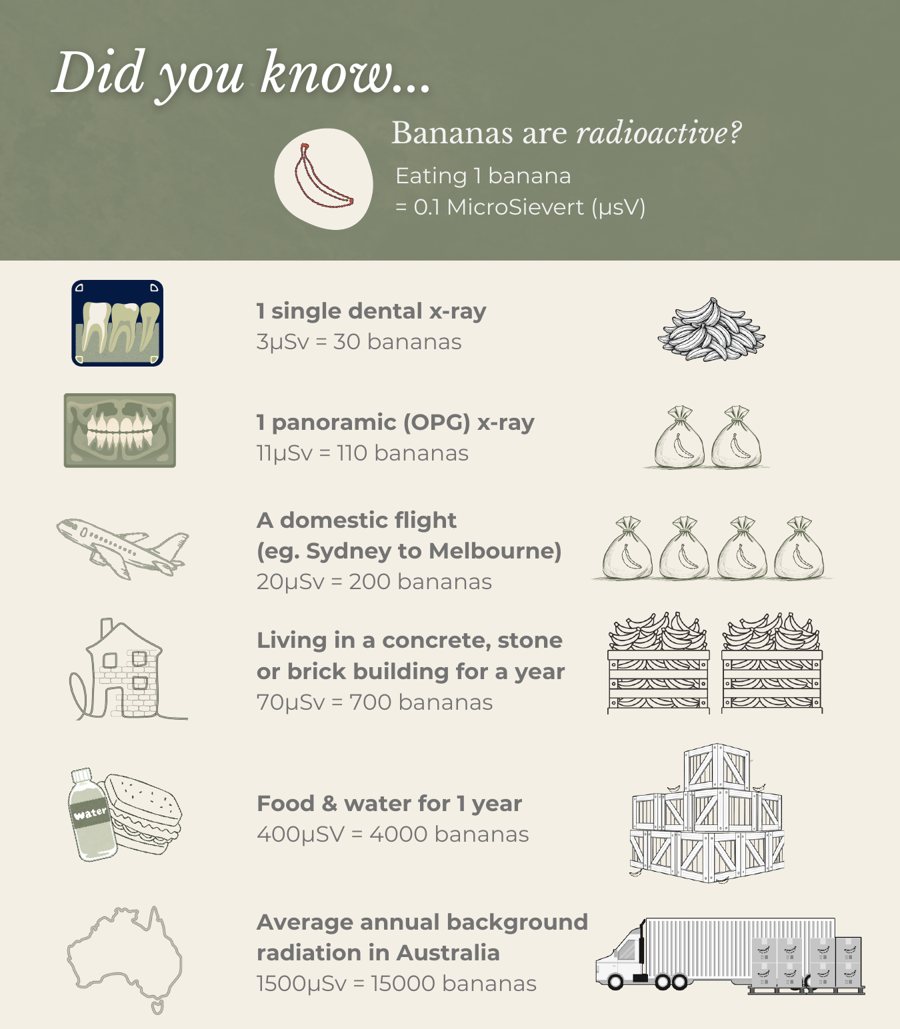
Dental x-rays in everyday terms. Typical doses compared with a banana (about 0.1 µSv). Exact doses vary with the machine and the type of image.
Putting the numbers in context
- A single dental x-ray taken inside the mouth is about 3 µSv, the same as around 30 bananas, and less than one day of natural background radiation.
- A panoramic x-ray (OPG), which shows both jaws in one image, is about 11 µSv, around three days of background radiation.
- A domestic flight from Sydney to Melbourne is about 20 µSv, more than a single dental x-ray and a panoramic x-ray combined.
- Living in a brick, stone or concrete building for a year adds about 70 µSv, and a year of food and water about 400 µSv.
Published dose figures vary a little between sources, depending on the equipment, the type of image and how the estimate was made, so treat these as a guide to the scale rather than exact values. What they agree on is the order of magnitude. Australia’s radiation safety agency, ARPANSA, describes the radiation exposure from dental imaging as very low level and unlikely to have health effects.
Why we take them
Much of what matters in a mouth can’t be seen by looking. Modern digital x-rays use a minimal dose and let us:
- Find early decay between the teeth, where it starts and where it’s invisible to the eye
- Monitor bone levels around the teeth, which is how gum disease is tracked
- Check for infection at the tips of the roots
- See teeth that haven’t come through yet, such as adult canines and wisdom teeth
- Check old fillings and crowns for problems underneath
Finding decay early usually means a small filling rather than a root canal or crown later, which is the real point of the x-ray.
How often do you need them?
For adults, we generally recommend:
- Intraoral x-rays (the small ones taken inside the mouth): every 2 years
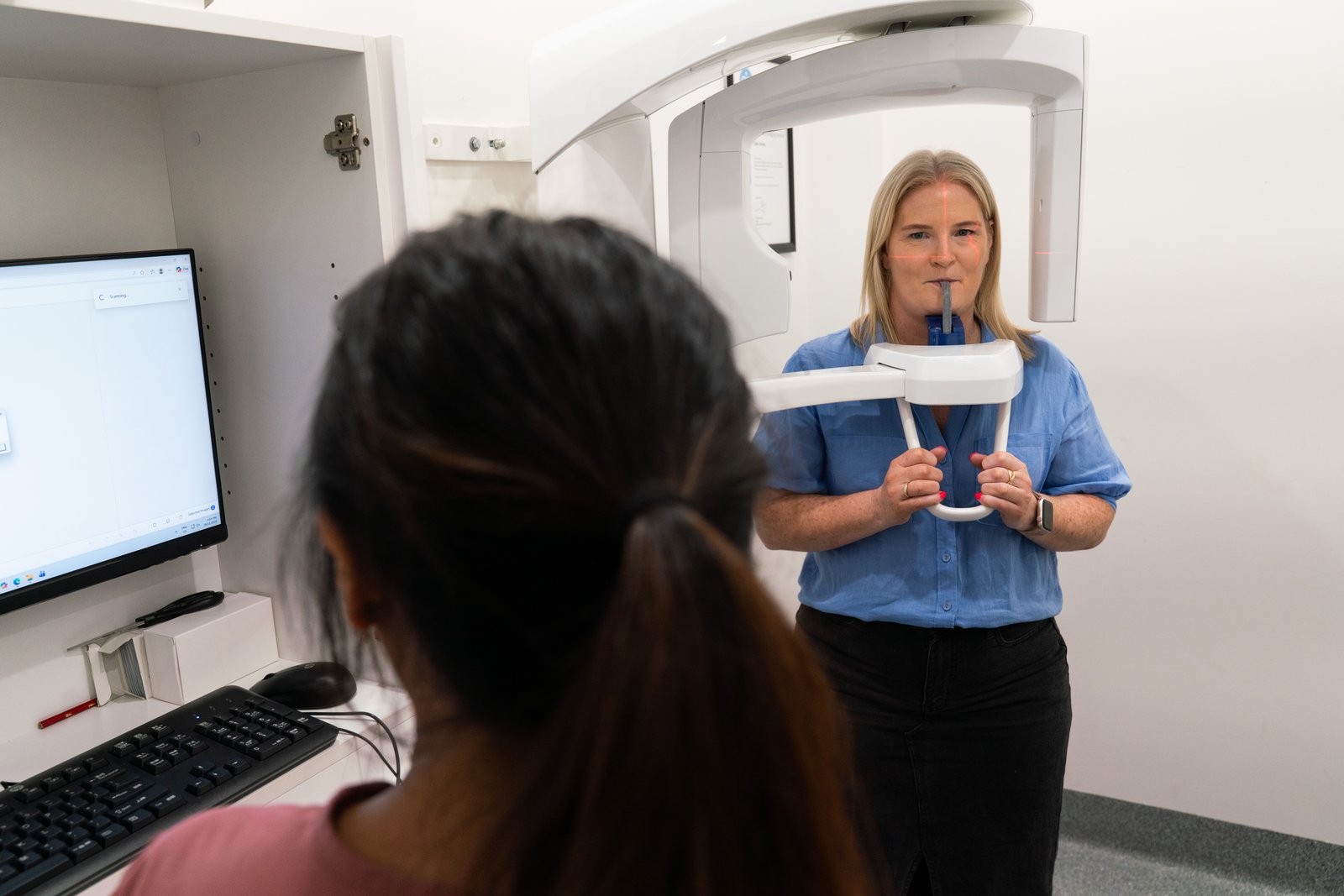
- Extraoral x-rays (OPGs), the panoramic view of both jaws: every 3 to 5 years
Some people need them more often so we can keep an eye on things, including anyone:
- Having braces, root canal treatment, or recovering from a dental injury
- At higher risk of decay
- With symptoms we are trying to get to the bottom of: pain, sensitivity that won’t settle, swelling, a tooth that has changed colour, or a bite that has started to feel different
- Being assessed for a specific problem, where the x-ray is what tells us which tooth is responsible and what is going on inside it
We only take x-rays when they’ll tell us something we need to know. If you’ve had x-rays recently at another practice, let us know, as we can often request them rather than repeat them.
Safety, children and pregnancy
We use digital x-rays, which need less radiation than older film, and follow the ALARA principle: keeping radiation as low as reasonably achievable by taking only the images that will change what we do. Because modern dental x-ray doses are so low and well controlled, ARPANSA advises that lead aprons aren’t routinely needed, and we don’t use them.
For children, we take a baseline panoramic x-ray (an OPG) from around age seven. One image shows every developing tooth at once: which adult teeth are there, which are missing, whether any are extra, and the path each one is travelling. That last point matters most for impacted adult teeth, which can drift into the root of the tooth beside them without any warning and with nothing to feel or see. Detecting impacted canines and impacted molars early on may prompt us to recommend early interceptive orthodontics to reduce the risk of losing any important teeth.
After that, how often x-rays are needed depends on their risk of decay and how their teeth are developing, so we decide case by case.
If you’re pregnant, tell us. Both the Australian Dental Association and ARPANSA advise that dental x-rays are safe at any stage of pregnancy: the dose is tiny, it is directed at the head, and what reaches a baby is smaller than a day of ordinary background radiation. So where an image will change what we do, we take it. That said, plenty of people would simply rather wait, and for routine or preventative care there is usually no harm in waiting, so we are happy to postpone those until after your baby arrives. In an emergency, such as finding the source of an infection, an x-ray is indicated: the dose is very low and treating the infection matters more.
The question tends to come up on the phone rather than in the chair, usually from someone ringing around the lower north shore comparing check-up and clean packages that list x-rays as an optional extra. We do not price them separately, so cost never decides how carefully we can look. That cuts both ways: we still only take an x-ray where there is a clinical reason for it. If you have any questions about x-rays at your next check-up, just ask. We’re happy to show you what we’re looking at and why. Book online or call us on (02) 9096 3895.
References
Australian Radiation Protection and Nuclear Safety Agency. Dental imaging. arpansa.gov.au
Australian Radiation Protection and Nuclear Safety Agency. Ionising radiation and health (fact sheet). arpansa.gov.au
Australian Radiation Protection and Nuclear Safety Agency. New radiation resource for dental patients. arpansa.gov.au
FAQs
1. Are dental x-rays safe?
Yes. A single dental x-ray is about 3 µSv, less than a day of natural background radiation in Australia, and ARPANSA considers the exposure very low level and unlikely to have health effects.
2. How often should I have dental x-rays?
For adults we generally recommend intraoral x-rays every 2 years and a panoramic x-ray every 3 to 5 years. You may need them more often if you have braces, root canal treatment, a dental injury or a higher risk of decay.
3. Why can’t you just look at my teeth?
Decay between the teeth, bone levels and infection at the root tips can’t be seen with the eye. X-rays find these problems while they’re still small.
4. Is a panoramic x-ray more radiation?
A little more than a single small x-ray, about 11 µSv, which is still less than a domestic flight from Sydney to Melbourne.
5. Can I have dental x-rays while pregnant?
Yes. The ADA and ARPANSA both advise that dental x-rays are safe at any stage of pregnancy. Many people prefer to wait for anything routine, which is fine by us, and in an emergency an x-ray is indicated: the dose is very low, and leaving an infection untreated carries more risk.
6. Do I need to wear a lead apron?
No. ARPANSA advises that modern dental x-ray doses are so low that lead aprons aren’t routinely required, and we follow the ALARA principle of keeping every dose as low as reasonably achievable.