
By Dr Emily So & Dr Alice Shan, Dentists
“I don’t want a crown. They shave your teeth down.” It’s one of the most common worries we hear, and it usually comes from a friend’s story or a video online. It deserves a straight answer, because the myth is half right in a way that leads people to the wrong decision.
Yes, a crown involves trimming the tooth. But a crown is only the right choice for a tooth that has already lost a lot of its strength, and for that tooth, a crown is what protects it. When a tooth is still mostly healthy, there are gentler options that trim far less.
Your teeth tell us which one they need
Crowns, onlays and veneers are often lumped together, and many people call all of them “caps”. They are different treatments for different problems:
- Crowns cover the entire visible tooth. They suit teeth that are severely broken down, or already repaired with large fillings.
- Onlays cover the chewing surface of a back tooth. They suit teeth with medium-sized decay, cracks or fillings.
- Veneers cover the front surface of a tooth, usually a front tooth, to improve the shape and colour of a healthy tooth.
- “Caps” usually means a crown or an onlay.
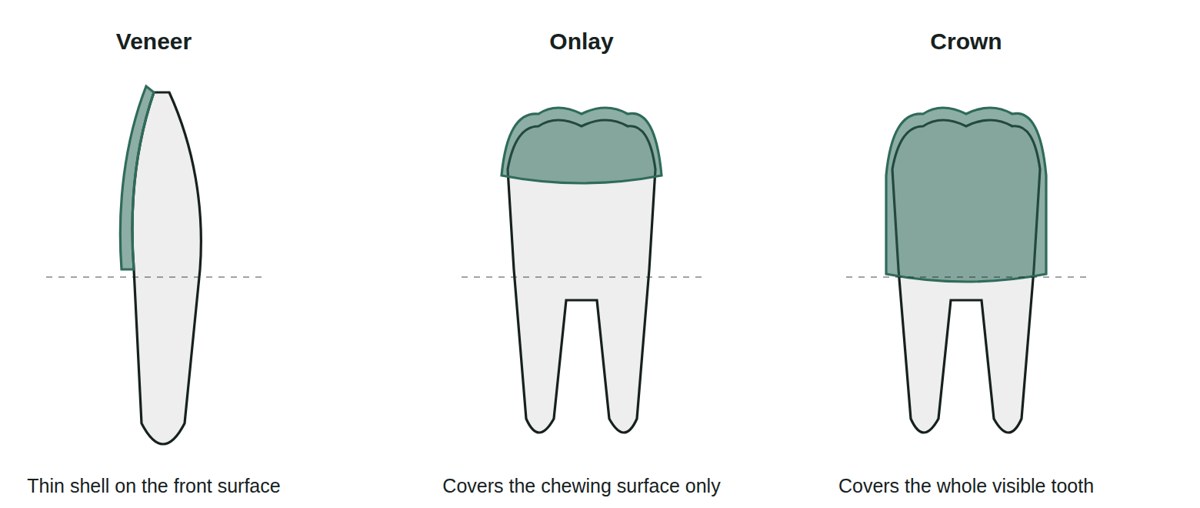
Veneer, onlay or crown. The shaded part is the restoration; the dashed line is the gum. The less of the tooth a restoration covers, the less tooth needs to be trimmed to make room for it.
How much tooth each one actually removes
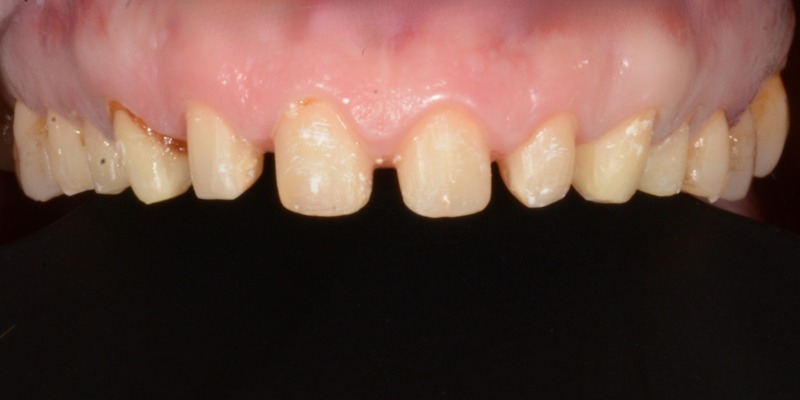
This has been measured. A study comparing preparations on front teeth found that a traditional veneer removed around 17% of the visible tooth structure, and the most minimal veneer design only about 8%. Full crown preparations removed between 64% and 72%.
That difference is exactly why the choice matters. A crown on a healthy tooth that only needed a veneer or an onlay would remove healthy tooth for no good reason. That’s the situation the myth is really describing, and it’s one we work to avoid.
Why a crown protects a tooth that needs one
The teeth that need crowns are rarely intact. They’re heavily filled, cracked, broken, worn down or root-canal treated. In these teeth, much of what gets trimmed is old filling material and damaged tooth, not healthy enamel.
What weakens a tooth like this is leaving it as it is. Large fillings leave thin walls that flex every time you chew, and cracks tend to spread. A crown wraps the remaining tooth and holds it together, so biting forces are shared across the whole tooth rather than concentrated on the weakest wall.
Root-canal-treated back teeth are the clearest example. In one long-term study, root-canal-treated teeth that weren’t crowned afterwards were lost at around six times the rate of those that were. That is an association from a retrospective study rather than proof, since people who chose crowns may have differed in other ways, but it lines up with what we see.
Crowns
A crown involves trimming the outer layer of a tooth so there’s enough space to fit a protective cap securely over it. Crowns suit teeth that are:
- Severely decayed
- Severely broken or cracked
- Severely worn from grinding or dental erosion
- Weakened by multiple or large fillings
- Weakened after root canal treatment
When a tooth is structurally compromised, a crown can restore its strength and appearance.
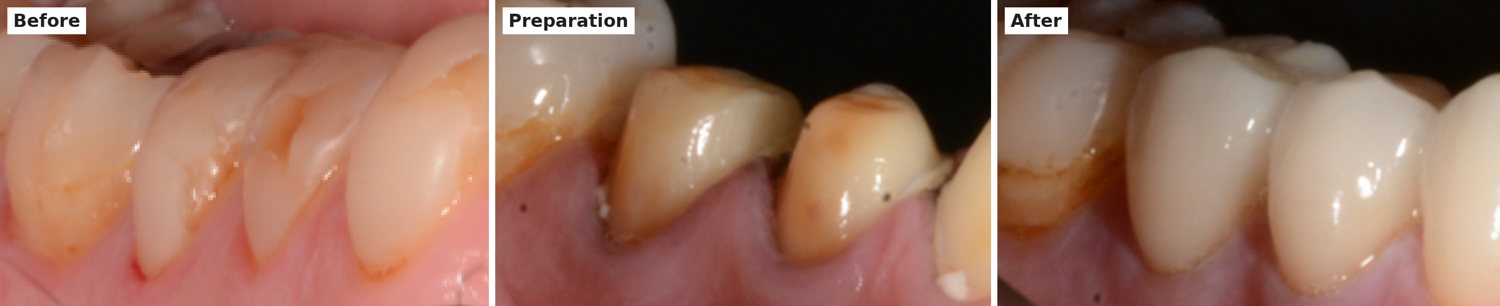
Crowns: before, preparation and after. Broken-down back teeth, built up and shaped with filling material first, then restored. Clinical example; individual results vary.
Onlays
An onlay involves trimming only the top chewing layer of a back tooth, and leaves the healthy sides alone. Onlays suit back teeth with:
- Medium-sized decay
- A broken cusp
- Cracks around old amalgam fillings
- Chewing surfaces flattened by grinding or dental erosion
- Root canal treatment, where enough healthy tooth remains
When a back tooth still has plenty of healthy enamel, an onlay can protect and reinforce it without the trimming a full crown needs.
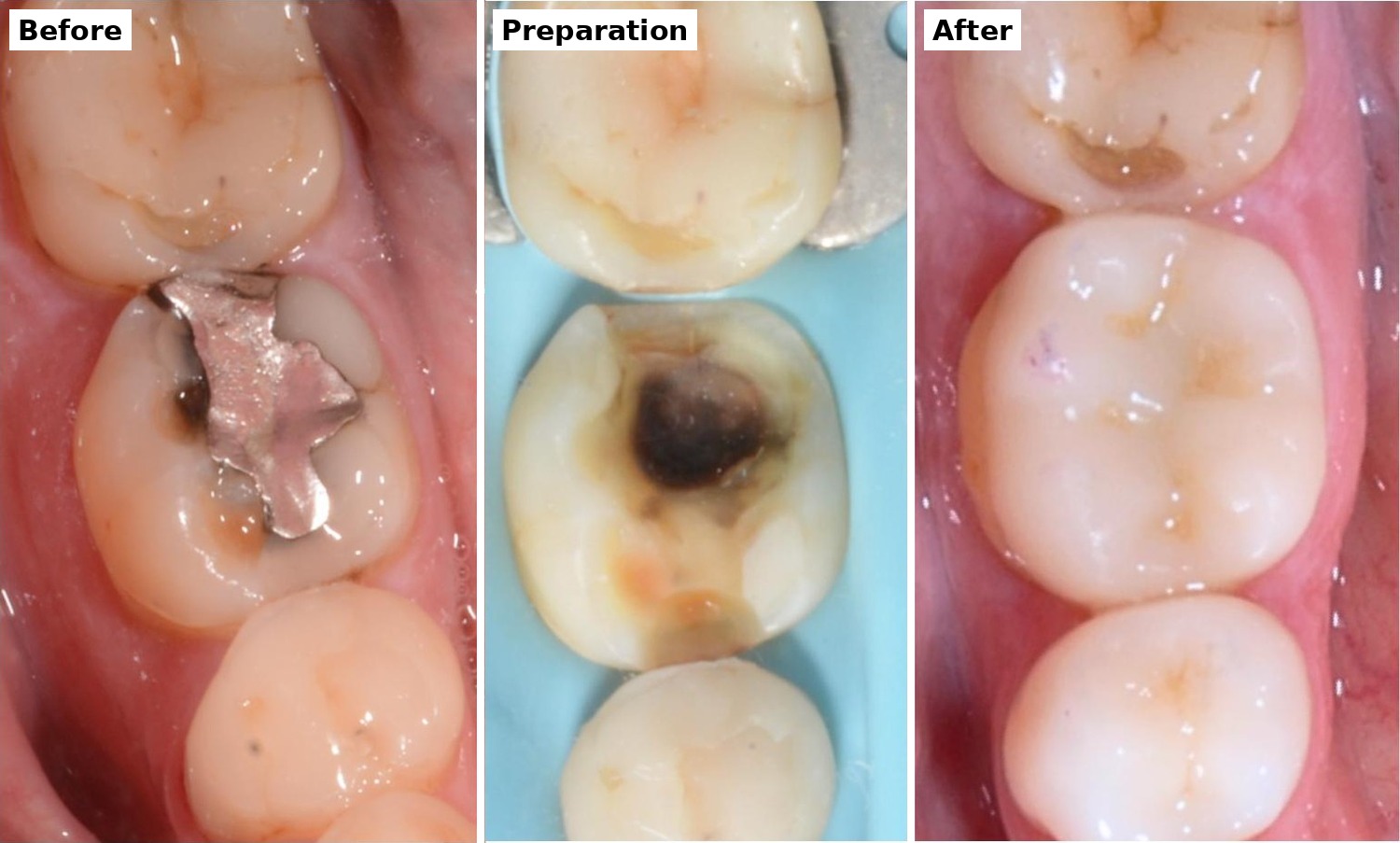
Composite onlay: before, preparation and after. An old amalgam filling with decay underneath, the amalgam removed and the thin, vulnerable cusps reduced, then a composite filling placed as an onlay over the top. Clinical example; individual results vary.
Gold is well suited to onlays on back teeth. It’s strong even when made thin, so it needs less trimming than other materials, and it wears at a rate close to natural enamel, so it’s gentle on the teeth it bites against.
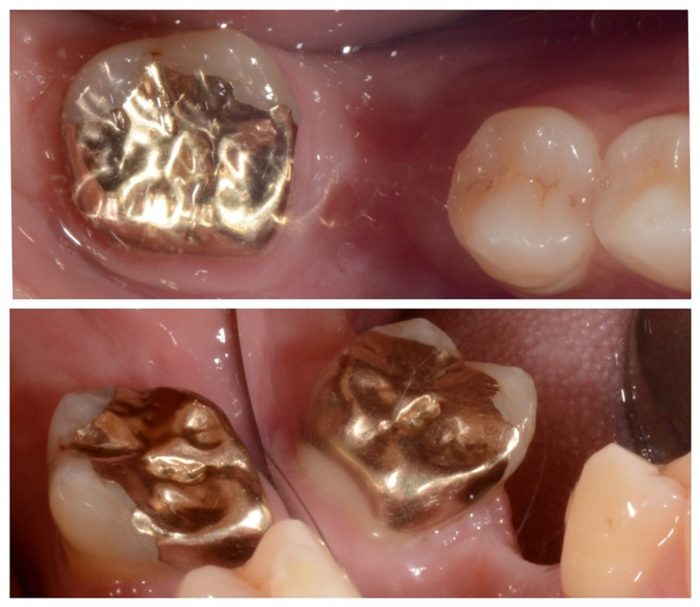
Gold onlays. Gold covers and protects the chewing surface while keeping the sides of the tooth intact. Clinical example; individual results vary.
Veneers
Veneers involve finely trimming the outermost front layer or edge of the tooth. Some veneers are purely additive, meaning there’s no trimming at all. Veneers suit healthy teeth with no or very small fillings, where the concern is:
- Discolouration that can’t be corrected by whitening
- Minor crowding
- Worn teeth
- Chipped teeth
- Gaps

Veneers: before, preparation and after. A gap between the front teeth, closed with veneers after only fine trimming of the front surfaces. Clinical example; individual results vary.
The principle: the least trimming that will do the job
The question isn’t whether crowns are good or bad. It’s which restoration protects this particular tooth while keeping the most of it. A healthy front tooth that needs a better shape might need a veneer, or no trimming at all. A back tooth with a cracked cusp might need an onlay. A root-canal-treated molar with little tooth left usually needs a crown. Matching the treatment to the tooth is what keeps teeth strong for longer.
Why choose Oaks Dental
Plenty of the crowns we see in Neutral Bay were done twenty or thirty years ago, when trimming the whole tooth was simply what was done, and they are not a sign that anyone did the wrong thing at the time. At Oaks Dental, we offer conservative treatment that focuses on preserving as much of your natural tooth as possible while providing strong, lasting protection. We’ll show you what we see in your tooth, explain which options suit it and why, and give you the costs in writing before anything starts. Book online or call us on (02) 9096 3895.
References
Edelhoff D, Sorensen JA. Tooth structure removal associated with various preparation designs for anterior teeth. Journal of Prosthetic Dentistry 2002;87(5):503–9. sciencedirect.com
Aquilino SA, Caplan DJ. Relationship between crown placement and the survival of endodontically treated teeth. Journal of Prosthetic Dentistry 2002;87(3):256–63. doi.org
FAQs
1. Do crowns weaken teeth?
Not when a crown is the right treatment. Crowns are for teeth that are already weakened, and a crown holds what’s left of the tooth together and protects it from breaking.
2. How much of my tooth is removed for a crown?
A full crown needs a layer trimmed from all sides, which on a front tooth is around two-thirds of the visible structure. In teeth that need crowns, much of that is old filling or damaged tooth. Where a tooth is healthier, an onlay or veneer removes far less.
3. What is the difference between a crown and an onlay?
A crown covers the whole visible tooth. An onlay covers only the chewing surface of a back tooth and leaves the healthy sides alone.
4. Do veneers damage teeth?
Veneers need only fine trimming of the front surface, and some need none at all. They’re suited to healthy teeth with little or no filling.
5. Is a cap the same as a crown?
“Cap” is an everyday word that usually means a crown or an onlay.
6. Why does a root-canal-treated tooth need a crown or onlay?
Not because the treatment makes the tooth brittle, which turns out to be a myth, but because a root-canal-treated back tooth has usually lost a lot of structure, including the ridges that brace it, which is what makes it prone to splitting. Covering the cusps shares the load across the whole tooth.