
Patient education | Straightening teeth
The Tooth With the Longest Journey: Impacted Canines and Why Age Nine Matters
A canine heading the wrong way can quietly dissolve the root of the tooth beside it. The check that prevents it takes ten seconds.
Of all the adult teeth, the upper canine travels furthest to get where it’s going. It forms high in the jaw, up near the floor of the nose, and then spends years working its way down and forward to arrive in the mouth at around eleven or twelve: last of the teeth at the front of the mouth to show up, and squeezing into whatever space is left.
A long journey means more opportunities to go off course. When a canine does, it usually heads towards the roof of the mouth rather than out towards the cheek, which is precisely the direction in which nobody can see it.
Why this matters more than a crooked tooth
If it were only a question of a canine ending up in an awkward position, it could wait. It isn’t.
A canine travelling the wrong way passes very close to the root of the adult lateral incisor beside it, and it can resorb that root: dissolve part of it away. The lateral incisor is a perfectly healthy tooth that has done nothing wrong, and the damage is permanent. The child feels nothing at all while it happens. There is no ache, no wobble, no warning.
How often does it happen? In one study that scanned 46 patients with impacted canines in three dimensions, the neighbouring lateral incisor showed some loss of root in around 28% of cases, and the central incisor in around 17%. Those figures come from a group who already had an impacted canine rather than from children in general, but they are the reason we treat the tooth next door as the thing at stake.
That is the real argument for looking early. Not the position of the canine, but the tooth next door.
The check that costs nothing
From about age nine, we run a finger high in the gum above where the canine should be sitting, on both sides. A firm bulge under the finger means the tooth is where it should be and heading the right way. It takes about ten seconds and it is part of a normal check-up.
What makes us look harder:
- No bulge that can be felt by ten or eleven
- A bulge that can be felt, but in the wrong place: too far forward or too high
- A clear difference between the two sides, particularly if the baby canine on one side is still rock solid while the other has gone
- An adult lateral incisor that has tipped or drifted, sometimes the first visible sign that something is pressing on it from behind
- A baby canine that simply hasn’t loosened when it should have
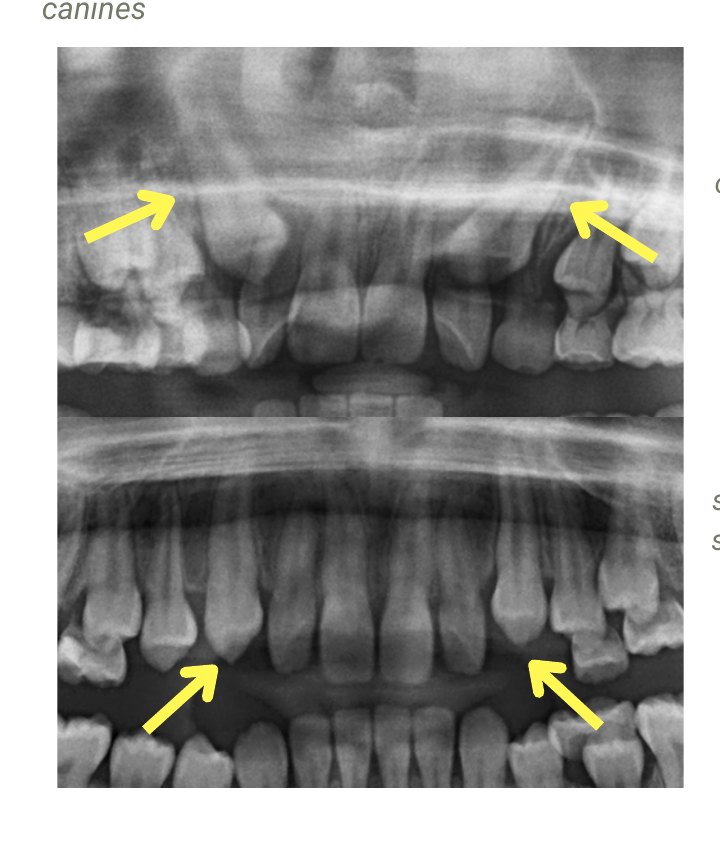
The finger tells us a limited amount, and only once the canine is close enough to feel. So we also take a baseline panoramic x-ray (an OPG) from around age seven, as part of how we screen every child. One image shows every developing tooth at once: which adult teeth are present, which are missing, whether any are extra, and the path each one is travelling. It gives us something to compare against later, which is what turns a single snapshot into useful information.
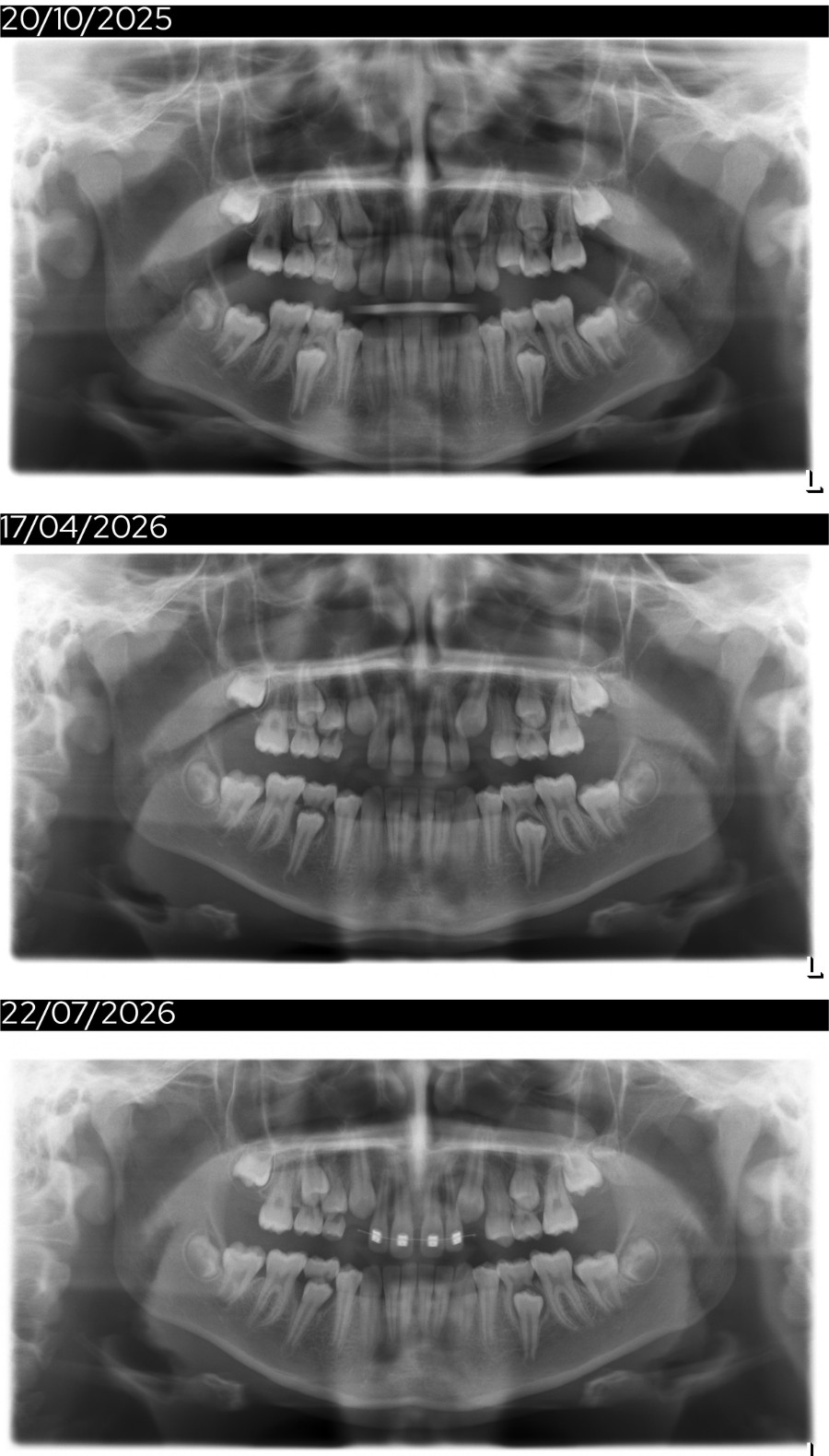
Seven is early for the canine itself, and that is the point. We are not looking for an impaction at seven. We are establishing where the tooth started, so that when we look again at nine or ten we can see whether it is tracking towards the space or drifting across the root of the tooth beside it.
Where that screening image suggests a canine is at high risk of impacting, a CBCT, which is a three dimensional scan, is then worth considering. It confirms the type of impaction, exactly where the tooth is sitting and which way it is pointing, and whether the roots of the teeth beside it have been affected. A flat panoramic image cannot show those things reliably. We do not scan every child: the OPG is the screen, and the CBCT answers a specific question once the screen has raised one.
How we judge the risk
Not every canine that looks misplaced will impact, and the useful question is not whether it is off course but how far. The framework we use comes from Ericson and Kurol’s work, which is still the reference point for this decision.
Two things on the x-ray carry most of the weight. The first is how far across the canine crown sits relative to the root of the lateral incisor beside it. The second is how steeply the canine is angled towards the midline. In their study of 46 palatally positioned canines, taking out the baby canine normalised the path in 91% of cases where the canine overlapped less than half of the lateral incisor root, and in 64% where it overlapped more. Put plainly: the further across it has drifted, the less likely a simple extraction is to fix it on its own. Other work has found that once the horizontal overlap passes half the width of the lateral incisor root, normal eruption is unlikely without something more.
There is a timeframe attached to this too. In that study, the canines that corrected themselves showed improvement within six to twelve months, and none corrected after twelve. So if we take out a baby canine and nothing has moved a year later, that is the signal to do something more, not to keep waiting.
The small intervention that often works
Here is the part that surprises parents. Where a canine is heading off course, taking out the baby canine at the right moment will often let the adult tooth correct its own path. No appliance, no braces, one small extraction.
It has decent evidence behind it, which is not something you can say about everything in this space. A systematic review and meta-analysis in the European Journal of Orthodontics pooled five randomised trials covering 214 children. Beyond twelve months, children who had the baby canine removed were roughly 1.8 times as likely to have the adult canine erupt successfully as those who had nothing done. The authors graded it moderate quality evidence. A later Cochrane review of the same question was more cautious, rating the certainty very low, with results consistent with anything from a substantial benefit to none, and finding no evidence that the extraction changes how many children ultimately need surgery. So it is worth doing, and the size of the benefit is genuinely uncertain.
Two details worth knowing. At the twelve-month mark there was no significant difference between the groups: this works slowly, and an early follow-up that shows nothing much is not a failure. And the review found no difference in root resorption of the neighbouring teeth between children who had the extraction and those who didn’t, so it isn’t a guaranteed protection either.
So: a small, inexpensive intervention that appears to improve the odds. Not a certainty. We’d rather say that than oversell it.
When extraction alone isn’t enough
This is the step most families never hear about, and it is the difference between a straightforward outcome and surgery later.
Removing the baby canine improves the odds. Adding early orthopaedic treatment improves them further. Individual studies report roughly this pattern, from a small number of trials rather than a settled evidence base:
- Left alone, roughly 30–40% of displaced canines find their own way in
- With the baby canine removed, around 65%
- With expansion added, around 66% in the randomised trial that tested it, against 14% in untreated controls
- With headgear added to the extraction, around 88%, against 65% for the extraction alone
Two things we do at this stage, depending on what the imaging and the arch are telling us:
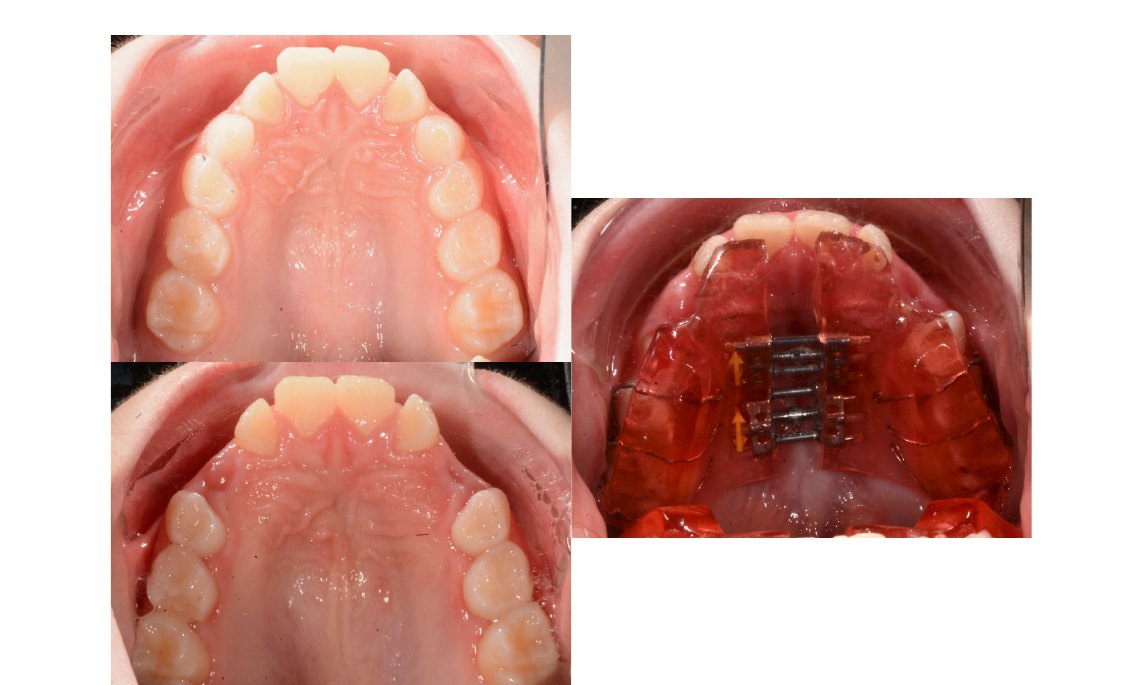
- Palatal expansion. Where the upper arch is narrow (which it frequently is in these children, and which is often part of why there was no room for the canine in the first place), widening it creates space along the path the canine is trying to travel.
- A short course of braces on the upper four front teeth. Sometimes called the Bach technique, this is a limited appliance on the incisors only, not full braces. It creates and holds space for the canine to come into, and just as importantly it moves the roots of the lateral incisors out of the canine’s way, clearing the corridor the tooth is trying to erupt through. It runs for months rather than years.
The point of all of it is one thing: improving the chance the canine erupts by itself, rather than needing to be surgically exposed and pulled into place during full braces later. That is the outcome we are working backwards from, and it is why we would rather do something small at nine or ten than something considerably larger at fourteen.
Timing matters here as much as anywhere. The published results are best when this is done at around ten to eleven, and success drops once the canine’s root has finished forming.
If that doesn’t work, or we’ve found it late
The usual next step is exposure and traction: the gum over the buried canine is opened, a small attachment with a fine gold chain is bonded to it, and the tooth is then guided into place orthodontically over a number of months. It works well, but it is a longer, more involved and more expensive road than one extraction at nine, which is the whole argument for looking early.
Occasionally the right answer is to leave the canine where it is and manage the space differently. That decision depends on the position, the health of the neighbouring roots and what the rest of the bite is doing.
What we do here
We palpate for canines at every check-up from nine, image where it’s warranted, and carry out the interceptive extraction. Where that isn’t enough on its own we provide the early orthopaedic step (palatal expansion, or a short course of braces on the upper four front teeth) and we manage the orthodontic side of exposure-and-traction cases where it comes to that. Where surgical exposure is needed we work with specialists such as an oral surgeon or periodontist, and where a case calls for specialist orthodontic care we refer to a registered specialist orthodontist.
If your child is eight or nine and due for a check-up, this is already part of what we look at: you don’t need to ask for it. If they’re older and nobody has ever mentioned canines, it’s worth raising. Book online or call us on (02) 9096 3895.
References
Alyammahi AS, Kaklamanos EG, Athanasiou AE. Effectiveness of extraction of primary canines for interceptive management of palatally displaced permanent canines: a systematic review and meta-analysis. European Journal of Orthodontics 2018;40(2):149–56. academic.oup.com
Ericson S, Kurol J. Early treatment of palatally erupting maxillary canines by extraction of the primary canines. European Journal of Orthodontics 1988;10(4):283–95. academic.oup.com
Almuhtaseb E, Mao J, Mahony D, Bader R, Zhang ZX. Three-dimensional localization of impacted canines and root resorption assessment using cone beam computed tomography. Journal of Huazhong University of Science and Technology (Medical Sciences) 2014;34(3):425–30. doi.org
Power SM, Short MB. An investigation into the response of palatally displaced canines to the removal of deciduous canines and an assessment of factors contributing to favourable eruption. British Journal of Orthodontics 1993;20(3):215–23. pubmed.ncbi.nlm.nih.gov
Baccetti T, Mucedero M, Leonardi M, Cozza P. Interceptive treatment of palatal impaction of maxillary canines with rapid maxillary expansion: a randomized clinical trial. American Journal of Orthodontics and Dentofacial Orthopedics 2009;136(5):657–61. pubmed.ncbi.nlm.nih.gov
Baccetti T, Leonardi M, Armi P. A randomized clinical study of two interceptive approaches to palatally displaced canines. European Journal of Orthodontics 2008;30(4):381–5. pubmed.ncbi.nlm.nih.gov
Edgren B. The fundamental objectives of early interceptive treatment. Orthodontic Practice US 2015;6(1):28–32.
Benson PE, Atwal A, Bazargani F, Parkin N, Thind B. Interventions for promoting the eruption of palatally displaced permanent canine teeth, without the need for surgical exposure, in children aged 9 to 14 years. Cochrane Database of Systematic Reviews 2021; CD012851.pub2. cochranelibrary.com
Palatally displaced canines: is there a way to prevent impaction of these teeth? Oral Health. www.oralhealthgroup.com
Frequently asked questions
How common are impacted canines?
Uncommon, but not rare, and they run in families. Because the consequence can be damage to a neighbouring tooth, the checking is worth doing on every child rather than only those with a family history.
Will my child feel anything if a canine is going the wrong way?
Almost always no. That’s the reason we feel for it rather than wait to be told.
Isn’t taking out a healthy baby tooth a bit drastic?
It’s a tooth that is due to fall out anyway, removed a little earlier than nature intended. Weighed against the alternative (surgery, an attachment and months of traction), most parents find it a straightforward trade.
How long before we know if it worked?
Longer than you’d like. The research shows the benefit emerging after twelve months, so we re-image at around a year and expect gradual change rather than a quick answer.
What happens if removing the baby canine doesn’t do it?
We escalate rather than wait. Palatal expansion or a short course of braces on the upper front teeth can redirect the canine, and the combined approaches have better published success than extraction alone. The aim throughout is to avoid needing the tooth surgically exposed later.
What if we’ve already missed the window?
It’s still very treatable: exposure and traction has a good track record. It’s just a bigger undertaking.
Why an x-ray at seven if the canine doesn’t arrive until eleven?
Because the useful question is what has changed. A baseline panoramic image at around seven shows every developing tooth and the path each is taking, so when we look again at nine or ten we can see whether the canine is tracking towards its space or drifting across the root next door. It also picks up missing and extra teeth while there is still time to plan around them.
How do you decide whether taking out the baby canine will be enough?
Mostly by how far across the canine has drifted on the x-ray. Where it overlaps less than half the root of the tooth beside it, the odds of it correcting after a simple extraction are good, around nine in ten in the original study. Where it has crossed further, they fall to roughly two in three, and we usually add expansion or a short course of braces rather than relying on the extraction alone.

About the authors
Dr Emily So and Dr Alice Shan are the principal dentists and co-owners of Oaks Dental in Neutral Bay. They are committed to providing thoughtful, evidence-based care that looks beyond treating individual teeth to support each patient’s overall oral health, function and wellbeing.
Disclaimer
All dental procedures involve potential risks and benefits. The information provided in this blog is general in nature and should not be taken as medical advice. We recommend that you seek guidance from a suitably qualified health professional before making decisions about your oral health. Where appropriate, you may also wish to consider obtaining a second opinion.
Any images or videos featured are shared with the informed consent of our patients and are intended for educational purposes only. They are not a guarantee of results, as every patient is unique. Treatment outcomes, including recovery, potential complications and effectiveness, can vary from person to person.
Has anyone checked your child’s canines?
From about age nine it is part of every check-up here. If your child is older and it has never come up, it is worth raising.